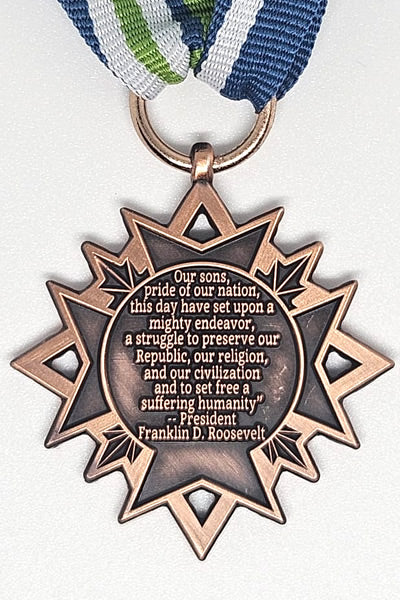
D-Day March - Rucking Tough Exclusive
D-Day March - Rucking Tough Exclusive
Ruck Window: June 4-8, 2026
Registration Deadline: June 3, 2026
Availability: Once per Year
What's Included
What's Included
Requirements
Requirements
**All rucks are "continuous" and can not be broken into parts
Tracking
Tracking
- Photo or screenshot of the tracking app of your choice that shows: Date, completion time, route and total kilometers (miles for US rucks)
- Photo of you participating in the ruck or marche (in uniform if a service member)
Each distance in this ruck honors a specific veteran from D-Day. Servicemen who exemplified courage, leadership, and selfless service. We invite you to ruck with us in special tribute to those who sacrificed everything on June, 6 1944.
Honor a real life. Choose the one you'll carry below:

40K Gold Medal - Technician Fifth Grade Waverly B. Woodson Jr
Technician Fifth Grade Waverly B. Woodson Jr. was a combat medic assigned to the 320th Barrage Balloon Battalion, one of the few African American units landing on Omaha Beach on June 6, 1944.
Within minutes of landing, Woodson’s landing craft was hit by enemy fire. Shrapnel tore into his groin, back, and legs. Despite being seriously wounded, he refused evacuation and immediately began treating other soldiers on the beach.
For nearly 30 continuous hours, Woodson worked under fire. He bandaged wounds, administered plasma, set fractures, and pulled injured soldiers from the surf as German artillery and machine guns raked Omaha Beach. At one point he amputated a soldier’s leg to save his life using limited medical supplies in battlefield conditions.
Exhausted and severely wounded himself, Woodson finally collapsed from blood loss and fatigue after saving countless lives.
Although his heroism was widely recognized by eyewitnesses and military records, he was awarded the Bronze Star rather than the Medal of Honor that many historians and veterans later argued he deserved. His story has since become one of the most powerful examples of courage and selfless service on D-Day.
Today, Woodson represents the quiet bravery of the medics who fought not with rifles—but with bandages, plasma, and sheer determination to keep others alive.

20K Silver Medal - Brigadier General Theodore Roosevelt Jr.
Brigadier General Theodore Roosevelt Jr., son of President Theodore Roosevelt, became one of the most iconic leaders of the Normandy invasion.
At 56 years old, suffering from arthritis and heart problems, Roosevelt insisted on landing with the first assault wave at Utah Beach on D-Day, June 6, 1944.
Armed with only a pistol and walking with a cane due to his injuries, Roosevelt moved among his troops under enemy fire, personally directing landing operations. When the first wave landed about one mile off course, he calmly assessed the situation and made the decision that changed the course of the assault.
His famous words: “We’ll start the war from right here.”
Roosevelt reorganized the landing troops on the spot, directing units inland toward their objectives. His leadership prevented confusion from turning into chaos and helped ensure the success of the Utah Beach landings.
For his extraordinary courage and leadership, Roosevelt was awarded the Medal of Honor, becoming the only general to land with the first wave of the Normandy invasion.
He died of a heart attack just over a month later in France, on July 12, 1944.
His leadership remains one of the defining moments of courage on D-Day.

12K Bronze Medal - Chaplain (Major) John G. Burkhalter
Chaplain (Major) John G. Burkhalter landed with American forces during the Normandy invasion on June 6, 1944, serving alongside soldiers on the beaches of France as both a spiritual leader and a battlefield presence.
Like many combat chaplains during World War II, Burkhalter entered the battlefield unarmed. His mission was not to fight, but to serve the soldiers around him—providing prayers, last rites, comfort for the wounded, and strength for the living.
Under fire and amid the chaos of the invasion, chaplains moved across the beaches and battlefield aid stations ministering to the dying and supporting the medics and soldiers who fought their way inland.
Burkhalter represented the unique role of military chaplains in war: standing alongside soldiers in the worst moments of combat, offering courage, faith, and dignity in the face of death.
During the Normandy campaign, chaplains like Burkhalter reminded soldiers that even in the brutality of war, compassion, faith, and humanity still had a place on the battlefield.
His service reflects the quiet but essential role of chaplains in caring for the spiritual and emotional welfare of soldiers in combat.